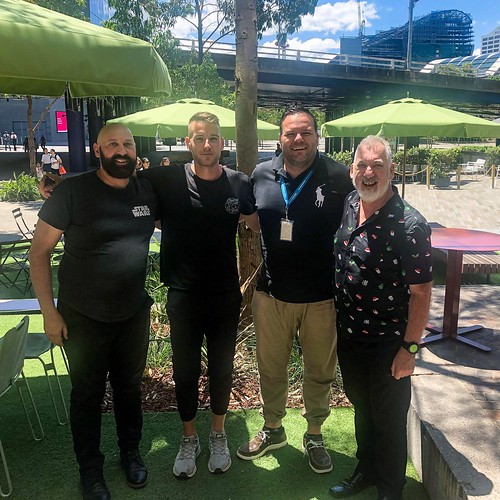
Today I took a brave first step towards future career-based networking. Simultaneously, I hope to renew my progress in attempting to lose some body mass and improve my flexibility. Diets and brisk walks around the block no longer seem to produce the dramatic effects I was experiencing in the 90s and 00s. So I have consulted with a professional personal trainer, whom I met last year while completing our mandatory one-day First Aid course.
I was able to relate the following anecdote concerning my introduction to secondary school sport:
One of the organisational things we had to do in those first days at high school in 1971 was to select a Sport, that we would be committed to every Tuesday afternoon. These were the times of 14- and 15-week school terms. I had never enjoyed class and house sport at primary school very much, and the thought of our high school choices – all of which required travelling away from the school for an afternoon – was really not appealing to me in any way. None of the possibilities on the list excited me. Ten-Pin Bowling and Ice-Skating were highly coveted – but way too popular – thus most places were reserved for those students who had participated in an Interschool team the previous term. That was never going to be me. I played it safe, choosing Tennis Coaching for Term 1 and Baseball for Term 2. (We didn’t have to choose Term 3 yet, but another rule was that no sport could be played two terms in a row. I figured Tennis Coaching was going to be tolerable, mainly because we would be taught the skills from scratch. I could even borrow Dad’s old tennis racket. A bus would be taking us to the courts and back, thus filling up most of the afternoon.
But my plans ground to a halt: my next six weeks of Term 1, I was confined to bed. I had been at high school for precisely one and a half days when I was diagnosed with (what was then known as) Infectious Hepatitis (later just “Hep A”). The remainder of that term was spent nursing my recovering liver in “Non Sport” (with all the students on sport detention, those with notes from their mothers, those who had managed to miss the bus, and those who had forgotten their sports gear). Luckily for me, the students with medical exemptions didn’t have to write our lines or multiplication tables.
Then came Term 2. I realised I could negotiate to do Tennis Coaching instead of the Baseball that I had been dreading. (So long as we didn’t do the same sport twice in a row.) Tennis Coaching was tolerable. The coach began calling me “Rod Laver”, which he thought was highly amusing.* The only extent of my resemblance to Rod Laver was my left-handedness; certainly not my undiscovered natural ability at performing amazing tennis moves. It would be a few more years before I realised who our coach actually was: a rather prominent referee in the world of professional tennis.
[* I should point out, through the lens of hindsight, this teasing by the coach might seem like bullying. It would definitely not be acceptable today. However, it never felt like malice at the time -and I don’t think the coach could believe that I kept bouncing back for more every second term. But I am still hopeless at all sports.]

Term 3 dragged itself along along and we had to select a new sport. Baseball wasn’t on offer as a Summer sport, of course, so the only other tolerable option seemed to be… Athletics. Ugh. We could walk to this venue and the teacher, who turned out to be the young art teacher who liked us to use his Christian name. He had begun his first year in teaching alongside the rest of the newbies. Coincidentally, he was also my Roll Call teacher that year. (He departed teaching after that one year; it would be a few more decades before I realised whom he would eventually become: a rather prominent identity in the professional art world, with numerous works on permanent exhibition in Australian and international galleries. Wow!)
Our Athletics teacher’s concept of athletics was definitely at odds with his artistic vision, so his seeming disinterest in sport probably suited “the nerds”, “the shirkers” and “the smokers” perfectly. And equally. A typical Term 3 afternoon consisted of “the athletes” sitting on the grass, in the shade of a large tree, surrounded by sporting equipment. The older students lit up their cigarettes* and the rest of us pulled at tufts of grass as we gossiped about whatever crossed our minds. A few played cards, probably for money. Our only random interruption was when someone would spot the sportsmaster strolling towards us with his checklist.
“Quick, everyone,” a voice would say, “Grab something and look busy.”
Suddenly, everyone was stubbing out butts, weighing up a shot-put in their hands, hefting a javelin, swinging a discus back and forth, dangerously close to others, or doing some halfhearted pushups. (The sportsmaster himself was already a rather prominent professional rugby union and rugby league player; I don’t think we fooled him one bit, but at least he didn’t bawl us out or put us on a detention list.) As the sportsmaster climbed back into his car, shaking his head sadly, we would returned to our spots under the shady tree. The cards and coins came back out. The cigarettes started glowing again. As you can appreciate, I was not setting any world on fire with my sporting prowess, and neither was anyone else.
[* Again, through the lens of hindsight, cigarettes in the secondary school environment came with some strange acceptances.]
The next year, Term 1 sport was no problem: I could safely go back to Tennis Coaching! Second time around didn’t improve my skills any, but it was a predictable option. One session was interrupted by an excursion to see one half of the movie David Copperfield – it had played with an unexpected Intermission, leading to us being taken back to school so the teachers could all be on their sports buses! I recall we actually missed the Tennis Coaching bus and had to walk all the way to the courts. It also set a precedent for the next year. Eventually the buses were cancelled and everyone had to make our way there on foot.
Term 2, of course, meant I could go back to Athletics! The art teacher had left at the end of the previous year. I presume he had to pay back his scholarship money to go back to his true calling. We turned up at the park. Our new mathematics teacher was dressed in appropriate sports gear instead of his familiar suit and tie. There was no equipment strewn on the grass. He soon put us to work, doing warmup stretches, pushups and back arches (which none of us could do). Then he schooled us in what we needed to know about breathing for our short sprints and then a longer jog. He took notes about our (lack of) ability in each activity. We were exhausted – and I hated it much as I hated any sport – but it was a contented type of exhaustion/hate that was both different and strangely comforting.
Something our maths teacher said made us ponder. We eventually checked out the school library’s copy of The Guinness Book of Records. In the Australian supplement at the back, there it was: Geoff J Smith was the Australian gold medal winner for the Decathlon at the 1970 Commonwealth Games in Edinburgh. (So, strangely enough, all four of these sporting coaches from my school days ended up being famous.) We actually enjoyed turning up to Athletics each week, and were proud that Mr Smith was proud of us. At the end of that term we could all do many pushups, we could all make it around the block without getting a stitch, and we could all perform a perfect back arch. (I probably still can.) I have never been that fit ever again. I really am grateful for the boost to my self-esteem. The memories are still vivid decades later.
Term 3 was back to… yes! Tennis Coaching! I still wasn’t much better, and we held out for Term 1 of the next year, so we could get back to Athletics. We even made a hopeful delegation to Mr Smith: would be still be our Athletics teacher? I remember him saying, “They’ll probably put me on Tiddlywinks or something…”. Crazily, Mr Smith was moved on to another Sport. He ended up supervising one of the sports that only required students names being marked off. What a waste or human resources. You know, I can’t even remember who our new Athletics teacher was. The next time we had to choose a sport, a group of us ended up in a swimming group (that managed not to actually ever get wet). Then there was always Tennis Coaching in the alternate terms… until we negotiated to do just Tennis, without the coaching; that quasi-debacle consisted of a small group of us strolling to a tennis court a few suburbs away and whacking a ball over the net halfheartedly, only ever springing into serious play when we spotted the sportsmaster parking his car nearby.
Anyway, here’s hoping my next few weeks/months of physical activity results in a contented type of nostalgic exhaustion/hate that is simultaneously different and strangely comforting.